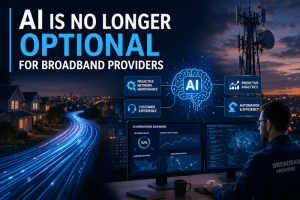

State-Level AI Regulation Surges as Telecom Providers Modernize Networks
In 2025, a broad surge of AI-related legislation is sweeping across many U.S. states, targeting private-sector uses of artificial intelligence, including high-risk automated decision systems, transparency obligations, and consumer protection frameworks.
For telecom carriers and broadband providers — many of which are rapidly integrating AI-based network automation, predictive maintenance, and customer-facing AI tools — these evolving laws carry potential compliance implications. As some states codify requirements for impact assessments, transparency, and risk management, broadband providers may need to ensure their AI-driven systems comply with state standards.
Growing Patchwork of State Laws
While the United States remains without a comprehensive federal AI regulatory regime, states are moving forward independently. In the absence of federal legislation, states retain full authority to regulate AI use within their territories.
According to the 2025 edition of a leading AI-law tracker:
-
Forty-two states introduced legislation this year relevant to private-sector AI deployment.
-
Some states have enacted laws — such as the Colorado AI Act (COAIA) — targeting “high-risk” AI systems. The Colorado law requires providers of such systems to perform impact assessments, impose safeguards against algorithmic discrimination, and disclose certain usage conditions.
-
Several additional states have proposed legislation loosely modeled after Colorado’s framework. That said, while some passed laws, others saw bills stall or die in committee.
Legal analysts caution that the resulting regulatory environment is becoming a complex patchwork. Many of the state laws vary significantly in scope, obligations, and enforcement mechanisms — complicating compliance for companies operating across multiple states.
Compliance and Operational Impact
For broadband providers, ISPs, and telecom carriers, state AI laws may impose new obligations regarding transparency, consumer notification, data handling, and risk mitigation. Automated decision systems — for example, in customer service bots, automated outage detection and remediation, or AI-assisted maintenance scheduling — could be subject to impact assessments or disclosures under specific laws.
Threat of Fragmentation and Compliance Costs
Because state laws currently diverge in scope and requirements, nationwide or multi-state operators may face administrative complexity akin to coping with multiple data-privacy or net-neutrality regimes. Some commentators warn that compliance burdens and associated costs — such as legal review, impact assessments, and audit documentation — may particularly burden smaller or regional providers.
Business Risk — Alongside Innovation Opportunity
While some AI regulation aims to guard consumer protections, enforce transparency, and prevent algorithmic harms, it also introduces potential legal and business risks for operators. Improper implementation or failure to comply could result in penalties, reputational damage, or restrictions on AI-enabled services. Conversely, providers that embed compliance by design — with robust governance, documentation, and transparency — may differentiate themselves as trustworthy, regulatory-ready providers.
Why This Matters Now — Telecom’s AI Adoption Accelerates
The wave of state AI legislation coincides with a period of rapid AI adoption across telecom networks, including AI-driven network management, predictive maintenance, anomaly detection, customer service automation, and even early experimentation with AI-native infrastructure. As carriers modernize their networks and embed AI deeply into operations, regulatory frameworks are struggling to keep pace.
In this dynamic environment, telecom and broadband operators face a critical moment of alignment — balancing innovation and automation with emerging regulatory requirements. The regulatory surge demands attention as network operators scale AI deployments.
The growing momentum of state-level AI regulation is reshaping the compliance landscape for broadband providers and telecom carriers. As states pass or consider laws governing automated decision systems, AI transparency, and risk management, operators must proactively evaluate their AI deployments — especially those that touch customer service, network automation, outage response, and decision tools. The patchwork nature of state laws means compliance will not be uniform and may impose a significant administrative and operational burden. For telecom operators embracing AI-driven modernization, regulatory readiness will soon be as important as technical competence.