
Telecoms Embrace AI to Modernize Customer Care
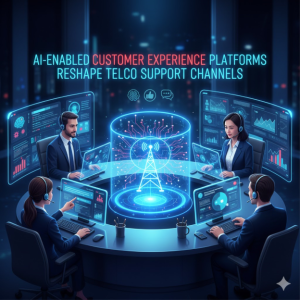 Telecommunications providers — both large carriers and regional ISPs — are increasingly deploying AI-enabled customer experience (CX) platforms to revamp traditional call centers and manual support workflows. The shift comes as the industry grapples with cost pressures, rising customer expectations, and the operational burdens of truck rolls and high call volumes. Industry analyses indicate that AI-driven support systems are helping carriers predict which subscribers may churn, preempt service disruptions, and streamline support interactions.
According to a recent telecom-industry overview, AI’s role in customer support is expanding beyond simple automation. Predictive models are being used to detect potential pain points before they escalate, enabling proactive service, while intelligent orchestration reduces the need for manual intervention.
Predictive Churn Modeling and Proactive Retention
AI systems now analyze usage patterns, customer interactions, service quality metrics, and support history to identify customers likely to leave. With early warning, providers can offer targeted retention measures or improved service — lowering churn rates and strengthening loyalty.
These predictive models rely on large datasets and sophisticated machine learning frameworks that have demonstrated high accuracy in identifying at-risk customers.
Intelligent Triage and Automated Support Workflows
When a customer reports a problem — via phone, chat, or digital portal — AI-driven platforms can immediately triage the issue, verify account and service status, and, in many cases, propose automated resolutions. This reduces time-to-resolution, lowers the burden on human agents, and mitigates the need for dispatching field technicians.
In several documented cases, AI-augmented support eliminated unnecessary truck rolls and resolved issues remotely, delivering substantial cost savings and faster service.
Personalized Service Recommendations and Customer Journey Optimization
Beyond reactive support, AI platforms are enabling telecom providers to tailor offers, recommend upgrades or value-added services, and optimize the customer journey with data-driven insights. This personalization helps improve user satisfaction and increases monetization and retention opportunities.
Operational Efficiency and Workforce Support
AI assists not only customers but also the workforce: automated routing, real-time analytics, and streamlined support workflows lighten agents’ load, reduce human error, and increase response consistency.
In addition, by reducing redundant field visits and automating routine tasks, AI-enabled platforms help carriers lower OPEX while maintaining or improving service quality.
Reduced Calls, Faster Troubleshooting, Fewer Truck Rolls
Some of the strongest indicators of AI’s value in telecom CX come from real-world deployments. One provider that adopted an AI-based service assurance platform documented an 86% reduction in troubleshooting time and a 15% drop in unnecessary truck rolls.
Another recent analysis notes that AI-driven predictive maintenance and automated fault monitoring have helped reduce outage incidents and minimize dispatches.
Collectively, these improvements — faster resolution, fewer field visits, and lower call volumes — suggest a shift from reactive, labor-intensive support models to proactive, AI-augmented customer care.
Broader Industry Drivers
Several factors drive the adoption of AI-enabled CX systems across telecom:
Cost pressures and network complexity: As networks become more complex (fiber, fixed wireless, 5G, hybrid), manual troubleshooting and dispatch become increasingly costly. AI can help manage those burdens at scale.
Customer expectations: Subscribers increasingly expect immediate, efficient support, minimal downtime, and personalized service — demands difficult to satisfy with traditional support models.
Competitive differentiation: Providers offering AI-driven customer experiences — with faster resolution and tailored offers — may gain a competitive advantage in markets with high broadband penetration and fierce competition.
Scalability and efficiency: For regional and rural broadband providers, AI platforms enable scaling support without proportionally increasing staff or operational costs.
Challenges and Considerations
While promising, the migration to AI-enabled support platforms is not without challenges:
Data privacy and security: Deploying predictive and personalized AI requires collecting and analyzing considerable customer data. Providers must ensure compliance with privacy laws and secure data handling practices.
Model accuracy and bias: Predictive models must be carefully trained and validated to avoid misidentifying at-risk customers or misdiagnosing issues — mistakes that could lead to customer dissatisfaction.
Integration with legacy systems: Many telcos operate legacy OSS/BSS infrastructure. Integrating AI platforms with these systems — and ensuring data quality and interoperability — remains a non-trivial undertaking.
Human-machine balance: While AI can streamline many tasks, specific customer interactions — such as disputes, billing issues, or complex outages — may still require human judgment and empathy. Over-reliance on automation can lead to a degraded customer experience if not carefully managed.
AI-enabled customer experience platforms are rapidly reshaping how telecom providers deliver support. By coupling predictive analytics, automated triage, personalized recommendations, and real-time support workflows, carriers can significantly reduce call volume, cut unnecessary truck rolls, and improve customer satisfaction — all while controlling costs. For providers navigating competitive broadband and telecom markets, AI-driven CX platforms represent a strategic lever for operational efficiency and customer retention.