
The Cost of Inaction

As labor costs rise, regulatory pressure intensifies, and customer expectations continue to increase, many service providers are discovering that the greatest operational risk is not technological disruption, but operational stagnation. The cost of inaction—manifested through fragmented systems, manual workflows, and reactive decision-making—quietly erodes margins and limits scalability.
Workforce Transformation in the Age of Agentic AI

As Agentic AI reshapes enterprise operations, concerns over workforce displacement are rising. History, however, shows that technological disruption consistently eliminates some roles while creating new, higher-value opportunities. The critical differentiator is upskilling—transforming workers to collaborate with intelligent systems rather than compete against them.
Generative AI and Agent-Based CX Frameworks Reshape Digital Care in Telecom

Telecommunications providers are redesigning customer experience frameworks around generative AI and autonomous agents, shifting from reactive support models to intent-driven, automated digital care as networks and services grow more complex.
AI Compute, Cloud Concentration, and Broadband Gaps Threatening Equitable Access
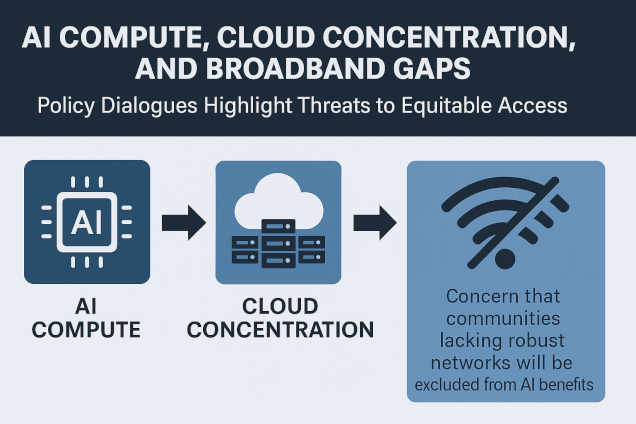
Policy discussions in 2025 are increasingly connecting the concentration of AI compute and cloud services with persistent broadband infrastructure disparities, warning that communities lacking robust networks risk exclusion from the economic and social benefits of generative artificial intelligence.
Trump AI Order Ties BEAD Funds to State Regulation, Widening Federal–State Divide
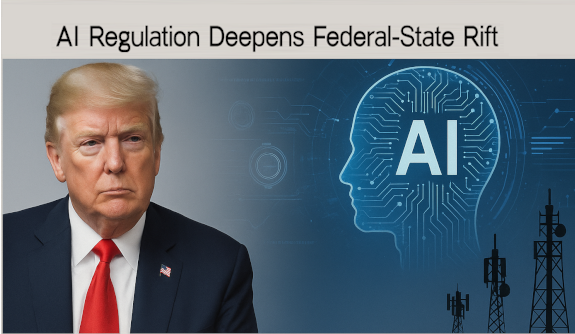
A December 2025 executive order signed by President Donald Trump conditions eligibility for remaining BEAD non-deployment funds on state compliance with federal priorities on artificial intelligence regulation, prompting legal, administrative, and broadband deployment uncertainties for state offices and private Internet Service Providers.
AI-Enhanced Spectrum Management and Interference Mitigation Tools Emerge

Artificial intelligence is reshaping spectrum operations as carriers and regulators face rising demand for mid-band and high-band frequencies. Advanced sensing models, real-time classifiers, and data-driven interference mitigation frameworks are emerging as critical tools for telecom operators navigating increasingly congested RF environments.
AI-Enabled Customer Experience Platforms Reshape Telco Support Channels

Telecom companies are swiftly upgrading their customer care operations with AI-powered support platforms that leverage predictive churn models, real-time service verification, automated triage, and personalized recommendation engines. These advances are lowering call volumes, reducing truck rolls, and reshaping how providers deliver service and support.
AI Regulation Gains Momentum as States Introduce Telecom-Focused AI Governance Models

Across the United States, an expanding roster of state legislatures is adopting or advancing AI-governance laws that may directly affect broadband and telecom providers — especially in areas such as network monitoring, automated decision-making, customer service automation, outage response, and consumer protections. For broadband operators and ISPs, the regulatory wave underscores growing compliance responsibilities even as networks adopt AI-driven operations.
Telecoms Expand AI-Native Infrastructure to Support 5G Core and Early 6G Prototypes
Major telecom operators are investing heavily in AI-optimized data planes, RAN intelligence layers, and distributed computing resources. These efforts — including new collaborations with hyperscalers and AI-chip manufacturers — are aimed at delivering ultra-low-latency connectivity, advanced network slicing, and readiness for early 6G deployments.