
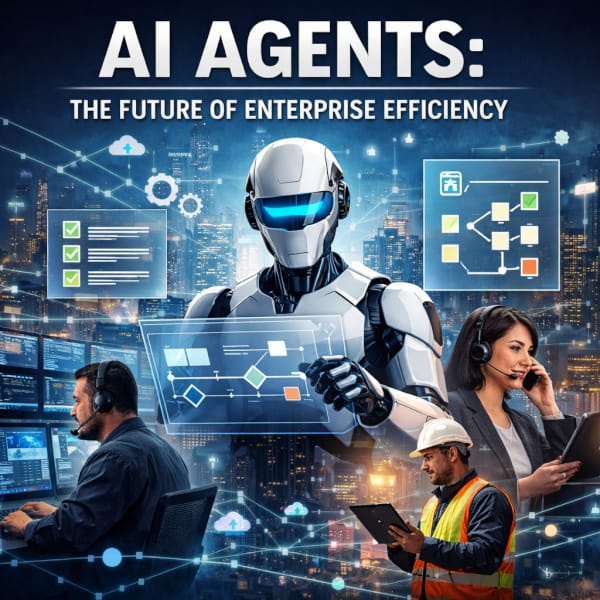
February 21, 2026 — The enterprise conversation around artificial intelligence is changing. After a surge of generative tools that excel at drafting text and answering questions, many organizations are now concentrating on a more operational promise: systems that can take action across software environments, follow a plan, and complete work steps under defined controls. That promise is increasingly being marketed and adopted under a common label: AI agents.
 The shift is partly a reaction to a stubborn measurement problem. Despite rapid growth in usage, productivity gains have been uneven and difficult to attribute. A National Bureau of Economic Research (NBER) working paper based on firm surveys found that a large majority of firms saw no measurable productivity gains from AI over the prior three years, even as expectations for future gains remain high. That gap between enthusiasm and outcomes is pushing executives toward agentic systems designed to operate within workflows rather than alongside them.
From “copilot” to “operator.”
In vendor terms, the difference is simple: copilots help humans do work; agents are positioned to execute work.
Microsoft has described agents as a new application model in an AI-powered environment, promoting autonomous agent capabilities tied to Copilot Studio and business systems. ServiceNow has taken a similar approach, announcing toolkits intended to build and orchestrate agents that can act across enterprise workflows and data. Salesforce, meanwhile, has positioned “digital labor” agents as capacity that can be spun up on demand and connected to customer and commerce processes.
Across these announcements, the common operating thesis is not that agents are smarter chatbots, but that they can reduce time lost to routine coordination: routing requests, gathering context across systems, drafting responses, proposing actions, and—in bounded cases—executing changes with approvals.
Why are service industries adopting first?
Agentic systems are showing up earliest in service-heavy environments because service organizations are built on repeatable patterns: requests arrive, work must be categorized, an owner assigned, dependencies checked, and a resolution path followed. Where those steps span multiple tools, ticketing, customer relationship management (CRM), inventory, scheduling, billing, and knowledge bases, manual effort expands quickly.
In practical terms, the strongest near-term efficiency use cases tend to cluster in five areas:
Front-line triage and resolution (categorizing issues, retrieving account or device context, recommending fixes).
Back-office workflow execution (routing approvals, generating documentation, reconciling records).
Field service coordination (scheduling, parts availability, dispatch optimization, status updates).
Customer communications orchestration (consistent messaging during incidents, proactive updates).
Policy and compliance enforcement (ensuring actions follow controls, logging decisions, and audit trails).
These are not “moonshots.” They are areas where the work is already structured, but slowed by system fragmentation and human handoffs.
The caution: many agent projects will fail
The rapid commercialization of AI agents does not guarantee successful deployment. Gartner has warned that a large share of agentic projects are likely to be canceled within a few years, citing rising costs, unclear business value, and insufficient risk controls. That forecast has become a practical guidepost for enterprise leaders: if you cannot define the process boundary, data access rules, approval gates, and success metrics, agent deployments can sprawl into expensive pilots without durable value.
The cancellation risk is not theoretical. Agents introduce new failure modes: acting on stale data, misrouting work, triggering unintended system changes, or producing outputs that appear authoritative but are not verifiable. The governance answer is not to avoid agentic automation, but to treat agents as operational actors that require the same guardrails as any other production system: least-privilege access, logging, monitoring, and controlled rollout.
What “good” looks like in production
Enterprises that succeed with agents tend to adopt an approach closer to industrialization than experimentation:
Start with one workflow that has measurable pain (e.g., reduce mean time to resolution (Mean Time to Resolution (MTTR)) for a known incident class).
Bind the agent to a limited toolset (ticketing, knowledge base, and a read-only inventory API first).
Add approvals before actions (recommendation → human approval → execution), then tighten based on performance.
Instrument outcomes (cycle time, backlog aging, re-open rates, customer contacts avoided, compliance exceptions).
Use layered fallback (when confidence is low, escalate; when data is missing, request it; never guess).
This discipline aligns with the market realities described by NBER and Gartner: value is not automatic and is not evenly distributed. The organizations that benefit most are those that connect agent capability to process design and operating metrics, rather than relying on model novelty.