

Executive Summary
Internet Service Providers (ISPs) are under constant pressure to grow efficiently, defend market share, and allocate marketing dollars with precision. Yet many providers still make campaign decisions with limited visibility into where the best opportunities exist, how competitors are positioned, and whether a given investment is likely to produce an acceptable return. This creates waste, slows expansion, and increases the likelihood that marketing budgets are spent in areas with low conversion potential.
Bavardio Growth addresses this challenge by bringing market intelligence, competitive awareness, data enrichment, and campaign economics into a single operating environment. Powered by Nexus, Bavardio Growth enables providers to view customers, leads, competitors, and unserved or underserved households on one map, then transform that visibility into measurable subscriber growth. Rather than relying on disconnected spreadsheets, assumptions, or delayed reporting, ISPs can identify target zones, assess competitive conditions, enrich household data, model campaign return on investment, and launch campaigns from within the same platform.
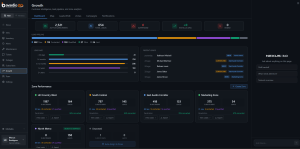
The result is a more disciplined and repeatable growth process. Bavardio Growth helps providers decide where to invest, why a specific zone is attractive, what message is likely to resonate, and how quickly a campaign may pay back. For operators seeking a more intelligent and accountable approach to marketing, Bavardio Growth shifts campaign planning from guesswork to operational decision-making.
The Business Problem: Where Should an ISP Invest Its Marketing Dollars?
One of the most persistent questions facing service providers is simple: where should we spend to grow? While the question appears straightforward, the answer is rarely supported by complete data. Many marketing decisions are still made without a unified view of serviceable households, local competition, lead density, or likely conversion economics.
In practical terms, providers often struggle with several issues at once. They may know where they already serve customers, but not where their next-best growth pockets exist. They may have partial lead data, but not enough verified household information to execute a high-performing campaign. They may suspect that a neighborhood is attractive, but not know how pricing or technology competition in that area affects their chances of winning. Most importantly, they may launch campaigns without a clear understanding of the likely cost per acquisition or the time required to recover the investment.
These gaps create material business risk. Marketing funds may be spread too broadly. Sales teams may pursue poorly qualified opportunities. Competitive messaging may lack the specificity needed to persuade a household to switch providers. Campaign performance may be difficult to compare across neighborhoods because the underlying planning assumptions were never standardized.
Bavardio Growth was designed to solve this exact problem.
The Bavardio Growth Approach
Bavardio Growth provides a map-based intelligence layer for subscriber acquisition. Everything relevant to market expansion lives in one environment powered by Nexus: existing customers, current leads, competitor information, household opportunity, campaign economics, and workflow tracking.
This unified approach matters because growth decisions are not isolated activities. A target zone is only valuable if the provider can understand the demand potential inside it. Competitive awareness is only useful if it informs the offer and message. Data enrichment is only meaningful if it gives the sales and marketing team actionable contact information. Return-on-investment modeling only matters if it is directly tied to campaign execution.
Bavardio Growth connects these functions so that ISPs can move from visibility to action without switching systems or waiting on separate teams to compile reports. It is a practical growth engine built around geographic targeting, operational clarity, and measurable outcomes.
Step 1: Define the Target Zone
The first step in the Bavardio Growth process is geographic definition. Within the platform, the provider can draw a zone directly on the coverage map around any neighborhood, community, housing development, or service cluster. This gives the operator immediate control over campaign boundaries rather than forcing planning around static reports or generic market segments.
Once the zone is saved, Bavardio Growth automatically populates the essential operating metrics for that area. The platform shows how many active customers already live within the zone, how many leads are already known there, the estimated total number of households, and the provider’s current penetration rate. These metrics are delivered instantly.
That immediacy has strategic value. Instead of waiting for a report to be built or exported, decision-makers can evaluate an area in real time. A neighborhood with low existing penetration but high household density may warrant aggressive attention. A zone with high customer density but limited adjacent opportunity may not warrant the same level of spend. Bavardio Growth enables operators to make those assessments quickly and consistently.
This step establishes the foundation for all that follows. A campaign cannot be optimized until the provider clearly understands the shape and size of the opportunity area.
Step 2: Build Competitive Awareness
Subscriber growth is rarely achieved in a vacuum. Every target zone exists within a competitive environment, and effective campaigns must account for it. Bavardio Growth incorporates competitive data at the zone level so providers can understand which companies are active in the area, what technologies they use, and how their offers compare.
This includes visibility into whether competing providers offer fiber, fixed wireless, cable, or satellite service, as well as their monthly rates. Bavardio Growth places this information alongside the ISP’s own pricing, giving sales and marketing teams a direct, side-by-side comparison.
This matters because winning a household often depends on more than broad branding. The message must be rooted in a real competitive advantage. In one zone, the advantage may be price. In another, it may be performance, local support, reliability, service symmetry, or upgrade potential. Bavardio Growth helps identify that advantage and translate it into practical campaign positioning.
When competitive intelligence is integrated into the planning process, the provider can move beyond generic messaging and create more precise offers. This increases the likelihood that campaign dollars align with the realities of the local market.
Step 3: Enrich the Opportunity Data
Knowing that households exist inside a zone is not enough. To execute effectively, providers need usable contact data. Bavardio Growth includes a Data Enrichment function that shows how much information is already known about households within each zone, including names, email addresses, and phone numbers.
The platform presents this through clear progress indicators so teams can immediately see where data coverage is strong and where gaps remain. From there, enrichment can be run to improve record completeness.
This is a critical operational benefit. Many campaigns fail not because the target market was wrong, but because the contact data was incomplete or insufficient for outreach. Addresses alone may support direct mail, but a stronger campaign often includes email and sales follow-up. Enrichment transforms a partially known market into a more actionable one.
For sales teams, this means they are not starting from a blank map or a list of serviceable addresses with no supporting detail. Instead, they receive better-informed opportunities with more complete contact records. For marketing teams, it means campaign execution can be more targeted, coordinated, and measurable.
Step 4: Model Campaign Economics Before Spending
This step is where Bavardio Growth becomes especially powerful for business decision-making. The Campaign ROI Calculator allows the provider to model expected performance before launching a campaign. Rather than relying on instinct, the operator can evaluate whether the numbers support investment.
The calculator allows the user to input the cost per mailer, including low-cost options such as Every Door Direct Mail postcards and email, the expected response rate, the expected conversion rate, and the average revenue per subscriber. Based on these inputs, Bavardio Growth computes total campaign cost, expected new subscribers, cost per acquisition, and estimated payback period.
This creates an accountability framework for marketing. A provider can compare two zones and determine which one is likely to generate more subscribers at a lower cost. A campaign that appears attractive on a map may prove less compelling once the projected cost per acquisition is calculated. Another zone may reveal a shorter payback period and therefore a better use of limited marketing funds.
The ability to model return before launch supports better governance over spend. It also creates a repeatable methodology that executive leaders can use to compare performance assumptions across campaigns, regions, and time periods.
Step 5: Launch the Campaign from the Same System
Once the provider has identified a promising zone, reviewed the competition, enriched the data, and validated the economics, Bavardio Growth enables campaign creation directly from the same screen. The platform includes customizable templates, allowing the provider to move from planning to execution without rebuilding the campaign process elsewhere.
This continuity is important. Too often, insight lives in one system while campaign execution occurs in another, increasing friction and introducing errors. Bavardio Growth keeps planning and action connected. Teams can launch campaigns with clearer intent and track the workflow from launch through completion.
Campaign tracking provides visibility into which zone is being targeted, which leads are included, and the current status. This gives both management and frontline teams a common operating picture. Marketing efforts become easier to monitor, compare, and refine over time.
Step 6: Repeat, Compare, and Prioritize
The real value of Bavardio Growth is not limited to a single campaign. Its full power emerges when providers repeat the process across multiple zones and use the results for comparative analysis.
An ISP can create zones across its service territory, apply the same cost model to each, compare projected returns, and rank them by subscriber potential, cost per acquisition, and payback period. This creates a disciplined framework for investment prioritization.
Instead of asking, “Where should we market next?” the provider can ask, “Which zone offers the best likely return based on current conditions?” That is a materially stronger question. It turns growth into a strategic operating process rather than a reactive marketing decision.
Over time, this approach can improve budget efficiency, reduce waste, strengthen campaign performance, and create a more durable subscriber-acquisition model.
Why Bavardio Growth Matters for ISPs
Bavardio Growth introduces intelligence into a part of the business that has often operated with limited precision. For many service providers, network planning, service delivery, and operations are managed with increasing sophistication, while marketing and subscriber acquisition remain fragmented or intuition-driven. Bavardio Growth helps close that gap.
The platform gives providers a way to unify market opportunity, competition, contact readiness, and financial planning within a single workflow. This supports better decisions by executives, better targeting by marketers, and better execution by sales teams.
It also helps answer the questions that matter most before dollars are committed. Where is the opportunity? What makes this zone attractive? How strong is the competition? Do we have enough household data to act? What is the likely cost of winning a new account? How quickly will the campaign pay back?
By addressing these questions directly, Bavardio Growth helps ISPs pursue growth with more confidence and more discipline.
Subscriber growth should not depend on incomplete visibility or assumptions about local demand. In a market where competition is increasingly localized and acquisition costs must be managed carefully, providers need better tools to decide where and how to invest.
Bavardio Growth provides that capability. Powered by Nexus, it brings together mapping, customer and lead intelligence, competitive awareness, data enrichment, return modeling, and campaign workflow into a single operating environment. It allows ISPs to identify opportunity zones, understand market dynamics, enrich contact records, evaluate likely returns, and launch campaigns with clearer economic justification.
The outcome is straightforward: smarter decisions, more targeted execution, and a stronger path from market visibility to subscriber growth.
To help providers experience the platform directly, Bavardio is offering a limited introductory opportunity. Schedule a demo of the Bavardio platform powered by Nexus before April 15, and Bavardio will run your first campaign of 25 live doors at no cost.