The Real Divide: Tool or Platform?
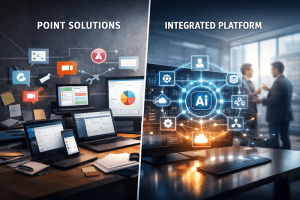
For years, enterprises have addressed operational pain with point tools. A call center adds a ticketing application. A network team installs another for alerts. A field team adopts a separate dispatch system. Each purchase can make sense in isolation. The larger problem appears later, when leadership discovers that the organization has solved individual tasks without creating a shared operating model.
That distinction sits at the center of the business case for integrated platforms such as Bavardio, which the article topic specifically frames as the counterpoint to one-off tools. The question is not whether a single tool can solve a challenge. It often can. The question is whether solving one challenge at a time creates a stronger enterprise, or a more fragmented one. That framing comes directly from the article brief provided by the user.
PTC, writing about point solutions versus platform solutions, defines point solutions as products designed for a single use case or challenge. It notes that these specialized tools often operate in isolation, leading to fragmented workflows and data silos. By contrast, it describes platform solutions as comprehensive environments that integrate multiple functions, reduce the need for separate tools, and streamline workflows inside a unified system.
That distinction matters more in 2026 because the software environment around most enterprises has become denser, not simpler. Okta reported in its 2025 Businesses at Work analysis that the average number of applications each company uses reached 101. IBM, in a 2025 enterprise AI announcement, argued that businesses are facing increasingly fragmented environments and said that scaling AI now requires integration, orchestration, and data readiness. Those two observations point to the same underlying problem: the tool count is rising faster than most organizations can coordinate it.
When a Tool Is Enough
There are still cases where a single tool is the right answer. A narrow operational problem, a short deployment window, a limited budget, or a highly specialized use case can justify it. PTC explicitly notes that point solutions can be quicker to deploy and may offer lower initial costs for targeted problem-solving.
That is important because the platform argument should not be overstated. Not every company needs to replace its operating environment just because it has found one pain point. In some cases, a focused tool can provide immediate relief with minimal disruption. In practical terms, a provider seeking to improve a single reporting function or automate a single isolated internal task may not need a broad platform first.
But the limits of the tool approach become more visible as soon as the workflow crosses departments. The same PTC analysis warns that multiple point solutions can become difficult to manage, harder to scale, and more expensive over time because integrations, licensing, onboarding, and training all add to the total cost of ownership.
IBM makes a parallel case from a data perspective. Its overview of data silos says that isolated systems leave teams working with fragmented or inconsistent data, degrade data quality, create duplicate workflows, and undermine machine learning and artificial intelligence efforts. IBM also notes that limited budgets and time often keep companies from adopting unified data platforms in favor of disconnected systems.
Why Integrated Platforms Are Gaining Ground
The rise of agentic artificial intelligence has changed the platform debate. Older software stacks could tolerate fragmentation for longer because a human worker often served as the bridge between systems. That person copied information from one application into another, reconciled records, and interpreted context manually. Agentic systems do not work best in that environment. They work best when context, permissions, workflow logic, and action pathways are already connected.
That is now explicit in the leading enterprise AI architecture language. OpenAI describes its Frontier business offering as a single enterprise platform integrated with systems of record, governed by enterprise-grade security, and designed to improve with experience as agents do real work. It says enterprise context should connect data warehouses, customer relationship management tools, and internal apps so agents can work with the same information people do. It also says business process automation succeeds when agents can run end-to-end workflows across systems of record, with auditing, permissions, and observability built in.
IBM is making a similar point. In its 2025 announcement, the company said enterprises are shifting from AI that chats to systems that work, but many will struggle if they cannot integrate agents across apps, data, and environments. IBM’s agent strategy emphasizes orchestration, lifecycle observability, governance, and integration with dozens of enterprise applications.
Gartner’s August 2025 forecast adds market weight to that direction. It predicted that 40 percent of enterprise applications would include integrated task-specific AI agents by the end of 2026, up from less than 5 percent at the time of publication. More importantly, Gartner said enterprise applications are evolving from tools that support individual productivity into platforms that enable autonomous collaboration and workflow orchestration.
Where Bavardio Fits
Within that framework, Bavardio is best understood not as a single utility but as the type of integrated operational platform the market is increasingly rewarding. The article’s brief explicitly positions Bavardio as the example of an integrated platform rather than a one-off tool.
That framing aligns with broader market logic. If a provider or enterprise buys a single tool to address a single problem, it may gain local efficiency. If it adopts a platform that connects workflows, shared context, governance controls, and operational actions, it has a better chance of creating institutional efficiency. The difference is in the scale of impact. One tool improves a task. A platform can improve the way work moves.
There is also a governance dimension. NIST’s AI Risk Management Framework Playbook says organizations should operationalize AI through four functions: Govern, Map, Measure, and Manage. That language favors systems that can centralize policy, traceability, and accountability. As AI moves deeper into operations, these controls become harder to maintain across disconnected tools and easier to enforce through integrated architectures.
Final Takeaway
The strongest business argument for an integrated platform is not that every standalone tool is bad. It is that disconnected success does not equal operational coherence. A point tool can solve a challenge. A platform can connect the people, data, controls, and actions around that challenge.
That is the difference enterprises are increasingly being forced to confront. In a world of 100-plus applications, rising AI adoption, and growing governance expectations, the real choice is no longer only about features. It is about whether the organization wants another instrument or a system that can conduct the whole orchestra.