Artificial intelligence is no longer sitting at the edge of the marketing stack. It is moving into the center of campaign planning, creative generation, audience discovery, optimization, and increasingly, the commercial pathways that turn ad exposure into transactions. Over the past year, large platforms, advertising groups, and model providers have pushed beyond the simple use case of “write me an ad” and into something more consequential: AI systems that help shape where campaigns run, how creative is assembled, which users see which message, and what happens after a consumer decides to buy.
That shift is visible across several layers of the market. Google has expanded its use of artificial intelligence in advertising through AI Max for Search campaigns, a suite designed to broaden search matching, adapt creative, and capture what it describes as new signals of intent. Google said advertisers using AI Max typically see 14 percent more conversions or conversion value at similar cost efficiency, with higher gains for campaigns that had relied heavily on exact- and phrase-match keywords. The company has also tied this effort to a broader shift in search behavior, arguing that more exploratory and multimodal search is creating new advertising moments that traditional keyword-based methods were not designed to capture.
Emerging Strategies in Advertising Automation
Amazon is pursuing a parallel strategy, but with more emphasis on ad asset creation inside commerce workflows. Its advertising business has expanded generative tools, including Image Generator, Video Generator, Audio Generator, and a Creative Agent, all embedded in its ad console, demand-side platform, and API workflows. In June 2025, Amazon said its enhanced Video Generator was available to all U.S. advertisers and could transform static product imagery into more dynamic video units. That matters because the economic barrier to producing campaign-ready creative has historically been one of the biggest constraints on smaller advertisers. Amazon’s pitch is clear: lower creative friction, faster testing, and easier conversion of product data into usable ad inventory.
Meta’s direction points even further toward automation. Reuters reported in June 2025 that Meta was aiming to enable brands to create fully and target advertisements using AI tools by the end of 2026. According to that report, advertisers could eventually provide a product image and budget, with Meta’s system generating image, video, and text assets while also handling targeting and budget recommendations across Facebook and Instagram. Reuters also reported that Meta planned more dynamic personalization, allowing different versions of the same advertisement to be shown in real time based on factors such as geography. In that framing, the ad platform begins to resemble a managed outcome engine rather than a manual media-buying environment.
Foundation-model partnerships are becoming a major part of that transition. WPP, one of the largest advertising holding companies, announced in March 2025 that it had invested in Stability AI and would use the company’s visual media models across image, video, 3D, and audio. WPP said the partnership would feed directly into WPP Open, its AI-driven operating system, and support ideation, concept testing, and new production workflows. Later, in October 2025, WPP and Google announced a five-year expansion of their partnership, backed by a $400 million WPP spending commitment for Google technologies. WPP said the deal was intended to help brands create “hyper-relevant campaigns in days, not months,” while enabling real-time personalization at large scale.
From Isolated Access to Integrated Orchestration
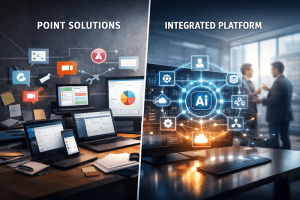
That agency-side evolution is important because it shows the market is moving beyond isolated access to models. The real commercial value is increasingly found in orchestration: how models connect to first-party data, media systems, commerce platforms, brand controls, and measurement loops. WPP Media has described this next phase as Open Intelligence, which it presents as a “Large Marketing Model” built on trillions of data signals and brand-specific tuning. Whatever one thinks of the branding, the idea reflects a broader industry ambition: sector-specific AI layers built not only to generate content, but to predict performance and improve allocation decisions.
Campaign Optimization and Creative Automation
OpenAI is also becoming more relevant to the advertising discussion, though its role is developing along two tracks. First, OpenAI is positioning ChatGPT and related products as tools for marketing teams to refine messaging, analyze campaigns, and work with internal business data under enterprise privacy controls. Second, OpenAI has begun outlining a direct advertising and commerce pathway inside ChatGPT itself. In January 2026, the company said it planned to test ads in the United States for ChatGPT Free and Go users, with sponsored placements clearly labeled and separated from organic answers. Earlier, in September 2025, OpenAI introduced “Buy it in ChatGPT,” Instant Checkout, and the Agentic Commerce Protocol, signaling that AI interfaces may become not just discovery surfaces but also transaction environments.
The most important takeaway is that AI in advertising is no longer just about faster production. It is about the gradual rewiring of the commercial stack. Search platforms are using AI to reinterpret intent. Retail media players are reducing the cost of creative execution. Agencies are partnering with model companies to build proprietary intelligence layers. Conversational AI companies are beginning to test sponsored discovery and checkout paths inside their own interfaces. The industry is moving from tool adoption to infrastructure change.