
The Funding Window Is Open
The United States is in the midst of the largest broadband infrastructure investment in its history. The Infrastructure Investment and Jobs Act of 2021 allocated $65 billion to broadband expansion, with $42.45 billion earmarked for the Broadband Equity, Access, and Deployment (BEAD) Program, administered by the National Telecommunications and Information Administration (NTIA).
States have begun finalizing their initial proposals, and deployment timelines are tightening. For broadband providers from regional fiber operators to large national carriers, the federal funding window represents both an extraordinary opportunity and a severe operational test. The problem is not money. It is readiness.
Operations Are Not Built For This Scale
Most broadband service providers, particularly small and mid-sized operators, were not designed to manage federally funded large-scale deployments. Their operational systems often rely on legacy tools: spreadsheets for project tracking, manual processes for permitting workflows, and disconnected platforms for network documentation. At the scale BEAD demands, those approaches break down quickly.
NTIA’s BEAD program requires granular documentation from coverage maps and cost-per-location data to performance benchmarks and labor certifications. Non-compliance with reporting standards can trigger funding clawbacks or disqualify providers from future rounds. The margin for operational error is narrow. Meanwhile, the FCC’s updated broadband fabric, launched as part of its Broadband Data Collection overhaul, requires providers to submit precise location-level coverage data. Inaccuracies in those submissions carry legal and financial consequences. Legacy operations were not built for this environment. AI-integrated systems are.
Where AI Changes The Equation
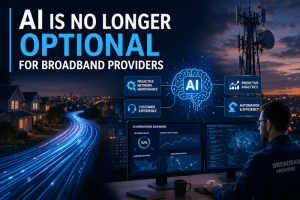
Artificial intelligence is not a futuristic concept in network operations. It is an active deployment tool already reshaping how carriers manage infrastructure, handle customer interactions, and meet compliance requirements. Predictive Network Maintenance AI-driven systems analyze network telemetry in real time to identify failure risks before outages occur. For BEAD-funded deployments, where service-level commitments are tied to federal contract performance standards, predictive maintenance reduces the risk of compliance violations resulting from unplanned downtime.
Automated Permitting and Workflow Management. Fiber deployment involves hundreds of permitting touch points across municipalities, utilities, and state agencies. AI-powered workflow platforms can track permit status, flag delays, auto-generate follow-up correspondence, and escalate stalled approvals functions that would otherwise require significant manual labor and constant human oversight.
Customer Operations and Churn Reduction: Agentic AI systems are increasingly used to handle tier-one customer support, proactive outage communications, and service-qualification queries. For providers scaling rapidly into new markets under federal grant programs, the ability to onboard customers efficiently while maintaining service quality is operationally critical.
Data Compliance and Reporting Automation BEAD’s reporting requirements are extensive. AI tools capable of aggregating deployment data, validating inputs against NTIA standards, and generating Audit-ready reports reduce the risk of submission errors and staff hours required to produce them.
The Workforce Reality
Labor shortages in broadband construction and technical operations are well-documented. Industry organizations, including NTCA and the Fiber Broadband Association, have reported that rural operators are competing for a limited pool of fiber technicians, project managers, and network engineers, even as demand for deployments is surging nationally. AI does not replace those workers. It extends their capacity.
Automated documentation, AI-assisted dispatch, and intelligent project management tools enable smaller teams to execute larger deployments without proportional increases in headcount. That is not a theoretical benefit. It is an operational necessity given current workforce constraints. Providers that fail to account for this dynamic when submitting BEAD applications risk committing to deployment schedules their teams cannot realistically meet.
Compliance Is The Quiet Risk
Much of the public conversation around BEAD and the Connected America buildout focuses on deployment speed and coverage targets. Less attention is paid to what happens after funding agreements are signed. Federal grant programs carry ongoing compliance obligations. Providers must report on construction progress, certify that the buildout meets program specifications, demonstrate that funded locations are being served at required speeds, and maintain records that satisfy federal audit standards.
For providers operating without integrated data systems and AI-assisted compliance tools, those obligations represent a sustained operational burden. Errors in reporting, even minor ones, can trigger reviews that delay reimbursements or create legal exposure. The providers best positioned to succeed in the BEAD era are those who treat operational modernization as a prerequisite, not an afterthought.
The Way Forward
The broadband deployment boom is here. The federal dollars are committed. The coverage mandates are set. What remains uncertain is whether enough providers will modernize their operations in time to execute at the scale the moment demands. AI integration is not a luxury reserved for large carriers. It is the infrastructure beneath the infrastructure, the operational layer, that determines whether fiber gets deployed on schedule, compliance gets maintained, and customers actually receive the service promised in federal grant applications.
Providers that move now, investing in AI-assisted operations before deployment timelines compress further, will hold a structural advantage. Those who wait may find themselves technically funded but operationally unprepared. In a program where performance is measured, audited, and tied directly to reimbursement, that distinction carries real consequences.