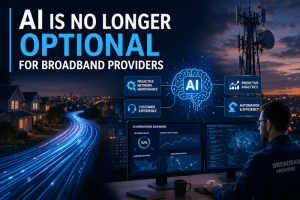
The modern service provider is under pressure from every direction at once. Networks are more complex, customer expectations are higher, labor remains expensive, and legacy systems still force teams to work across too many disconnected tools. In that environment, AI adoption is becoming less of a technology story and more of an operating-model story. McKinsey said in February 2026 that structural and cost pressures are pushing telecom operators toward AI to “reset network economics,” protect margins, and open new revenue opportunities. NVIDIA’s 2026 telecom survey reported that 90% of telecom respondents said AI is helping increase revenue and reduce costs, while 65% said AI is driving network automation.
A Comparative Perspective
By contrast, the non-adopting provider stays trapped in delay. Customer service agents must search across several systems to answer a single question. Supervisors rely on after-the-fact reports rather than real-time operational insights. Network teams spend more time responding to alarms than preventing incidents. Field dispatch remains slower because prioritization is manual, and information arrives late or incomplete. None of those weaknesses is dramatic on a single day. Over a quarter, however, they translate into higher operating costs, slower mean time to resolution, more inconsistent service, and a weaker customer experience. McKinsey warned in July 2025 that telecom operators facing stagnant revenue and cost pressure need next-generation efficiency levers, and that modern operators are already deploying AI across customer support and network management to remain competitive.
The advantage of the AI adopter is not only cost. It is also organizational learning. OECD research published in late 2025 found that 65.1% of SMEs using generative AI reported that it improved employee performance, and 45.2% reported that it helped save money. That matters for service providers because many operate with lean teams and depend on institutional knowledge that is often trapped in people rather than systems. When AI is used carefully, it can make frontline employees more effective, preserve organizational memory, and help smaller providers compete above their weight. But the same OECD research also cautioned that many firms still use generative AI mainly for peripheral rather than core activities. That is a warning against shallow adoption.
Strategies for Responsible AI Adoption and Governance
This is where the non-adopter often misunderstands the moment. The risk is not simply missing a software trend. The risk is allowing competitors to create faster operating loops. McKinsey’s 2025 AI survey found that only 39% of organizations reported enterprise-level EBIT impact from AI, even though use-case-level cost and revenue benefits were more common. That finding cuts two ways. It shows that AI is not magic and that benefits are real when implementation is disciplined. High performers are more likely to redesign workflows, secure leadership commitment, define validation processes, and build around data, talent, and scaling. The laggard who waits for perfect certainty may discover that the real penalty is strategic delay.
The service-provider sector has entered a period in which AI adoption is becoming a differentiator in execution, not just innovation. Current evidence does not support the idea that every AI deployment automatically produces a bottom-line transformation. It does support the narrower and more important claim that service providers using AI in customer care, network operations, and workflow redesign are positioning themselves to respond faster, operate leaner, and compete more effectively than those that remain dependent on manual, fragmented systems. The winners are unlikely to be the fastest experimenters alone. They will be the providers that combine AI adoption with disciplined process redesign, governance, and workforce enablement.