
 Artificial intelligence has crossed an important threshold in enterprise operations. The debate is no longer whether companies are experimenting with AI, but whether they can turn scattered use into measurable operating results. The latest data suggests that broad adoption is now the norm: McKinsey reported in March 2025 that 78% of respondents said their organizations use AI in at least one business function, while Stanford HAI’s 2025 AI Index likewise found that 78% of organizations reported using AI in 2024, up from 55% the year before. That level of penetration supports the core premise behind today’s enterprise AI market: the era of casual experimentation is giving way to execution.
Yet the more important story is not the adoption number itself. It is what organizations are trying to do with the technology. McKinsey’s 2025 survey makes a critical distinction between using AI and restructuring work around it. The report notes that AI use now ranges from limited experimentation by a few employees to deployment across business units that have “entirely redesigned” processes, but only 21% of respondents reporting generative AI use said their organizations had fundamentally redesigned at least some workflows. That gap matters because McKinsey found that workflow redesign had the strongest effect among the factors it tested on whether organizations reported earnings impact from generative AI. In the report’s words, “The value of AI comes from rewiring how companies run.”
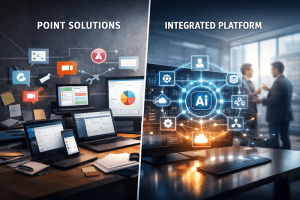
That finding is reinforced by Deloitte’s 2026 State of AI in the Enterprise report, which describes a market moving from pilot programs toward production, but not yet fully reimagined. Deloitte reports that worker access to AI rose by 50% in 2025 and that the number of companies with at least 40% of projects in production is expected to double in six months. Even so, just 34% are “truly reimagining the business.” In other words, scale is improving faster than transformation. Many companies are deploying AI into existing structures rather than rebuilding processes around its strengths.
This helps explain why many executives now speak less about replacement and more about augmentation. In practical terms, AI is most often used to handle repetitive drafting, summarization, search, coding assistance, service interactions, and data-heavy support tasks, while humans remain responsible for judgment, escalation, relationship management, and accountability. McKinsey’s workplace research, published in January 2025, concluded that employees are ready for AI and that leadership, not workforce reluctance, is the main barrier to scale. Stanford HAI’s 2025 Index adds that a growing body of research shows productivity gains and, in many cases, narrower skill gaps across the workforce.
Boston Consulting Group’s 2025 workplace survey points in the same direction. BCG reported that one-half of companies are moving beyond straightforward productivity plays to redesign workflows, a phase it calls “Reshape.” It also found that organizations actively reshaping workflows with AI are seeing stronger gains in time savings, decision-making, and strategic focus. Still, BCG cautions that deeper redesign creates workforce anxiety if leadership fails to pair new tools with training and clear operating models. Its conclusion is blunt: “The journey from AI adoption to impact is fundamentally about reshaping how people and machines collaborate.”
The current market, therefore, contains two truths at once. First, AI adoption is real, broad, and advancing. Second, the move from adoption to enterprise value remains uneven. McKinsey found that more than 80% of respondents said their organizations were not yet seeing a tangible enterprise-level earnings effect from generative AI, and only 17% said at least 5% of EBIT over the previous 12 months was attributable to generative AI use. That is not evidence of failure. It is evident that many firms are still early in the operational redesign cycle, even after AI has entered daily use.
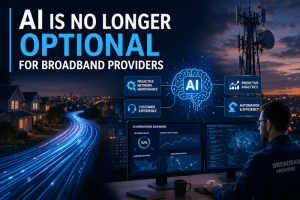
For operators in broadband, telecom, utilities, and field-service environments, this distinction is especially important. Operational AI becomes credible only when it is attached to a workflow: ticket handling, knowledge retrieval, field dispatch, service assurance, billing inquiries, compliance evidence gathering, outage triage, and technician guidance. In those settings, the most durable value does not come from novelty. It comes from compressing response time, reducing manual handoffs, improving consistency, and helping staff work with more context and fewer delays. The technology is most useful when it strengthens human execution rather than pretending to eliminate the human role altogether.
Workforce implications remain a central part of the story. The World Economic Forum’s Future of Jobs Report 2025, based on over 1,000 employers representing more than 14 million workers, frames AI as part of a broader labor-market transformation rather than a simple one-directional job-loss event. That framing aligns with the operational evidence now emerging from enterprise surveys: organizations are investing in reskilling, governance, and process adaptation because AI changes how work is organized, not merely who performs it.
The result is a more mature phase of the AI cycle. Enterprises are moving away from showcase pilots and toward harder questions about operating design. Where should automation end? Which workflows should be rebuilt from the ground up? What approvals must remain human? Which metrics prove value? Those questions now matter more than demo quality.
The evidence supports the central claim, with an important qualification. Around three-quarters of organizations are now using AI in at least one business function, and the market is clearly moving beyond experimentation. But widespread use is not the same as full transformation. The organizations seeing the strongest results are not merely installing AI tools; they are redesigning workflows, investing in governance, and using AI to augment employees in specific operational contexts. The next phase of enterprise AI will be decided less by who has access to models and more by who can embed them responsibly into the daily machinery of work.