
Enterprises Rebalance for Cost, Speed, and Scale

The commercial AI market is moving past the assumption that bigger always means better. As enterprises shift from experimentation to scaled deployment, smaller language models, lower-cost inference, and compute-efficient architectures are becoming central to how businesses buy, build, and operationalize AI.
Orbiting the AI Race

SpaceX is pushing a radical vision for solar-powered data centers in orbit just as OpenAI closes a record $122 billion funding round to expand terrestrial AI infrastructure. Together, the developments show how quickly the AI economy is becoming a contest over energy, compute, and physical scale.
Adopt AI or Fall Behind
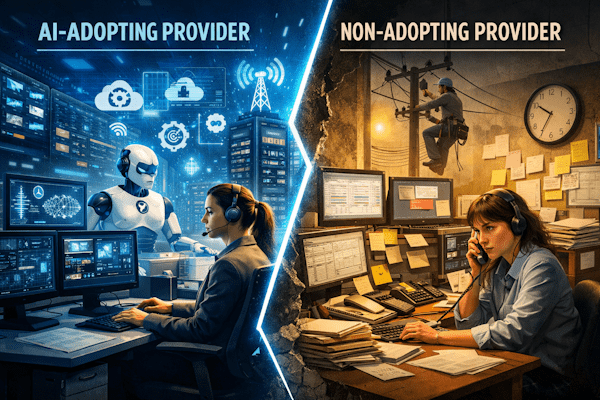
For service providers, the divide is no longer between companies experimenting with artificial intelligence and those waiting for perfect clarity. It is increasingly between operators who are redesigning customer service and operations around AI and those who are absorbing higher costs, slower response times, and weaker competitive positioning as rivals move ahead.
GTC 2026 Pushes Agentic AI Into the Real World
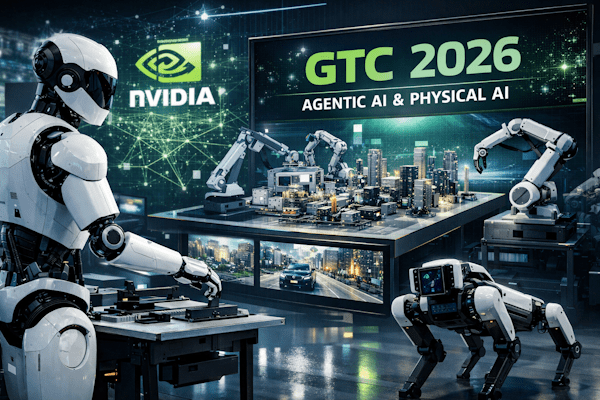
NVIDIA GTC 2026 made one point unmistakable: artificial intelligence is moving beyond chat and copilots into agentic systems that can plan, act, and increasingly operate in physical environments. The shift is being reinforced by parallel advances across the market, including video-trained action models built on internet-scale datasets.
AI Ads Find a New Engine

Artificial intelligence is moving deeper into marketing and advertising, not only as a copy and image tool, but as a campaign engine tied to targeting, measurement, commerce, and platform partnerships. The shift now underway suggests that advertisers are beginning to treat foundation models and agentic systems as operating infrastructure rather than experimental creative aids.
How AI Is Reshaping the Org Chart

Companies are moving past isolated artificial intelligence pilots and into a harder phase: redesigning work itself. The most successful adopters are not merely adding tools; they are rebuilding teams, governance, and daily workflows around human-and-AI collaboration.
AI Enters the Network

Artificial intelligence is moving from back-office telecom analytics into the live architecture of radio, edge, and cloud networks. Vendors including Huawei, Samsung, Ericsson, Nokia, and NVIDIA are now positioning AI as part of how 5G-Advanced and future 6G systems will be built, optimized, and monetized.
The Data Center Pause Before the Buildout

A new bill from Sen. Bernie Sanders and Rep. Alexandria Ocasio-Cortez would halt the construction of new AI data centers until Congress enacts national AI safeguards. The proposal is unlikely to become law soon, but it has become an important marker in the fight over how fast the United States should build the infrastructure behind artificial intelligence.
Who Will Write the Rules for AI?

Global AI governance is becoming more multilateral. The United Nations, UNESCO, the OECD, the Group of Seven (G7), and the Council of Europe are all pushing frameworks for safety, transparency, rights, and risk management, even as major economies continue to diverge on openness, industrial policy, and state control.
Vertical AI

Agentic Artificial Intelligence (Agentic AI) and multimodal models are moving from general chat tools into industry-specific platforms. The next wave is being built around execution: systems that can read documents, interpret images, process voice or sensor inputs, and act across business workflows in finance, healthcare, logistics, and manufacturing.